Institutional knowledge, staff voice and the possibility of knowledge extraction in an AI-mediated university
Paul Morrill
Independent Researcher
First published: October 2026
Abstract
Higher education has increasingly organised itself around activities and outputs that can be standardised, measured, audited and reproduced at scale. Generative artificial intelligence (GenAI) is unusually capable of producing and processing many of these same outputs. This essay considers what might follow. As institutional fluency and scalable knowledge production become less scarce, forms of human contribution that are more difficult to measure, including tacit knowledge, judgement, dissent and relational work, may become relatively more important.
GenAI may also reduce some of the linguistic and presentational barriers that influence whose ideas are heard within institutions. It could therefore provide a means of aggregating dispersed staff knowledge about the student experience and identifying problems or ideas that conventional hierarchical structures fail to surface. The same capacity raises a less comfortable possibility. Under financial constraint, institutions could use AI to capture staff tacit knowledge, convert parts of it into reusable organisational resources and incorporate those resources into scalable digital provision. This might reduce institutional dependence upon the people from whom the knowledge originated.
The essay develops an augmentation–extraction hypothesis to describe these divergent possibilities. It does not claim that AI-mediated knowledge capture is currently being used to replace staff in higher education. Rather, it records in October 2026 a set of conditions from which such an outcome appears plausible enough to warrant consideration.
Keywords: artificial intelligence, higher education, tacit knowledge, knowledge management, staff voice, scalability, digital education, organisational knowledge
Introduction
Higher education may have spent the last few decades preparing itself remarkably well for artificial intelligence, although not necessarily in the technological sense. Universities have become increasingly comfortable with activities that can be standardised, measured, compared and reproduced. Strategies, frameworks, learning outcomes, performance indicators, impact statements and dashboards are now familiar features of institutional life.
There are perfectly reasonable explanations for this. Universities are large organisations spending substantial amounts of public and private money, and accountability matters. So do quality assurance and consistency. The difficulty arises when things that can readily be measured and reported begin to acquire greater institutional importance simply because they are easier to see.
Something similar may occur in the way universities recognise their people. Confidence, visibility and fluency in institutional language are readily apparent. Tacit understanding, quiet competence and the judgement acquired through years of doing a job are less easily represented. The ability to notice a problem that nobody has thought to measure is particularly awkward because, by definition, it is unlikely to appear on a dashboard.
This raises a question that has bothered me for some time. Have universities become particularly good at rewarding people who are good at being rewarded? This should not be read as an argument against confidence or leadership, nor as a romantic defence of quiet or awkward people. Quiet people can be wrong and confident people can be excellent leaders. The issue is whether institutional systems have attached disproportionate value to characteristics that are readily legible within those systems.
GenAI makes this worth reconsidering because it is becoming remarkably competent at producing some of the things organisations have learned to value. Polished prose, presentations, summaries, reports and other forms of institutional communication are becoming easier and cheaper to produce. If that continues, the ability to produce them may cease to distinguish people in quite the way it once did.
Higher education has spent decades increasing the value of what scales. AI may be about to make some of what scales considerably less scarce.
This essay considers two possible consequences. AI might reduce barriers to participation, surface staff knowledge that institutions currently fail to hear and release people from routine work so that they can concentrate on work requiring human judgement. Alternatively, the same technology might help organisations capture and formalise knowledge that previously remained closely associated with individual employees. Under financial pressure, that second capability raises a difficult question about whether knowledge capture could eventually reduce the institution's dependence upon the people who developed that knowledge.
The two outcomes are not predictions. They are possible paths emerging from developments that are already observable in 2026.
Scalability and institutional value
Scalability has obvious advantages in a large organisation. A standard process can be reproduced across departments, a metric compared between years, and information expressed in a familiar institutional form can move relatively easily through committees and management structures.
Experience does not always travel so conveniently.
A technician may know that a particular practical activity routinely causes students difficulty. An administrator may recognise exactly where students become lost within a process. A lecturer may know that an activity which appears successful according to formal measures is less useful than those measures suggest. Support staff may notice changes in student behaviour well before those changes become visible in retention or satisfaction data.
Much of this knowledge is difficult to capture because it has developed through experience. Polanyi's (1966) account of tacit knowledge remains relevant here: what people know is not exhausted by what they can readily state or document. Later work on organisational knowledge developed this distinction further. Nonaka et al. (2000), for example, described organisational knowledge creation as a dynamic interaction between tacit and explicit knowledge rather than a matter of simply storing information.
The problem becomes particularly visible when experienced employees leave. Organisations have worried about this for considerably longer than they have worried about GenAI. Hofer-Alfeis (2008) described the “leaving expert” problem and formal approaches to debriefing departing experts. Burmeister and Deller's (2016) systematic review similarly identified the retention of knowledge from older and retiring workers as an important organisational challenge.
More recent reviews of knowledge loss associated with organisational turnover reinforce the point. Klammer and Gueldenberg (2023) reviewed 91 empirical studies and found a substantial literature concerned with the antecedents and organisational effects of knowledge loss following both voluntary and involuntary turnover. The underlying problem is therefore not new. Employees leave, organisations restructure, people retire and some knowledge leaves with them.
The difficulty is that retaining knowledge is not equivalent to writing everything down. Wikström et al. (2018), studying senior employees in a multinational organisation, found that valuable knowledge could be subjective, tacit and developed through collaboration and participation in work. Their findings caution against treating knowledge retention as a simple process of capture and codification.
A manual can document a procedure without capturing all the judgement required to know when that procedure should not be followed.
GenAI does not remove this problem. It does, however, alter the practical possibilities surrounding it.
AI and the changing economics of knowledge capture
O'Sullivan et al. (2026) describe how GenAI can assist with eliciting tacit expertise through conversational interaction and synthesising the results into reusable knowledge artefacts. Their work is particularly relevant because it treats AI-mediated knowledge capture as a governance problem as well as a technical opportunity. Expertise may be difficult to articulate, knowledge can be distorted during transfer, contributors may withhold information and social processes that normally surround knowledge exchange can be weakened.
It would therefore be naïve to assume that an experienced employee can simply be interviewed by an AI system and somehow downloaded into a database.
Nevertheless, the economics of the problem have changed. A process that once required lengthy interviews, manual coding and substantial human analysis can increasingly be assisted by systems capable of working across large volumes of unstructured material. Hussinki et al. (2026) similarly examine how GenAI might interact with organisational knowledge-management systems and expose relationships within information that would otherwise be difficult to see.
Hussain's (2026) temporal knowledge continuity framework provides another useful development. Employee turnover is conceptualised as a disruption to organisational knowledge whose consequences may emerge only later. AI-enabled continuity systems are among the mechanisms considered for preserving organisational knowledge following departure.
The purpose of such systems is continuity, not workforce reduction. That distinction matters. Yet their appearance in this literature marks an important change. AI is moving beyond the production of content and becoming part of the infrastructure through which organisations may preserve what their people know.
This is where the argument developed here begins.
Institutional fluency and access to the floor
The same technology may affect who gets heard inside organisations. Institutional language has practical value, but fluency in it can also function as a gatekeeper. An employee capable of converting an observation into a polished proposal is likely to find it easier to have that observation taken seriously than someone who struggles to express the same idea in the expected register.
GenAI weakens that barrier. A member of staff who needs time to formulate a response no longer has to compete with the quickest speaker in the meeting. Someone working in a second or third language can concentrate more on the substance of an argument. A technician with extensive practical experience can receive help turning an observation into a structured proposal, while a lecturer who failed to articulate an objection during a meeting can formulate it afterwards.
This does not flatten organisational hierarchy, but it makes the language through which hierarchy operates more widely available. If institutional fluency becomes commonplace, organisations may eventually have to distinguish more carefully between the quality of an idea and the quality of its presentation.
There is a potentially democratising aspect to this. People whose knowledge has historically been difficult to express in the forms preferred by an organisation may gain another route into the conversation. AI, in this sense, is not simply supplying answers. It can provide access to forms of expression that previously carried their own barriers to entry.
There is also reason for caution. An articulate minority view is still capable of being wrong, and institutional outsiders should not be romanticised simply because they are outsiders. Nietzsche's discussion of the free spirit in Beyond Good and Evil offers a useful philosophical parallel, particularly his treatment of intellectual independence and distance from prevailing values (Nietzsche, 1886/2009). Nietzsche was plainly not writing about universities or organisational management, but the broader point is relevant: distance from a prevailing system can sometimes reveal assumptions that are harder to see from within it.
Sometimes an awkward employee is simply awkward. On other occasions, distance provides a useful view. A person who appears not to understand how the institution works may, occasionally, understand it rather too well.
AI as an institutional listening technology
This leads to a practical thought experiment. Universities may already contain much of the intelligence required to improve the student experience, dispersed among the people who work within them. The difficulty may be less that nobody knows what could be improved than that the institution has poor mechanisms for hearing what its staff already know.
Consider asking staff across a university a straightforward question: If you could change one thing about the way this university works tomorrow, solely to improve the student experience, what would you change?
Responses could be anonymous where necessary, and people could write or dictate their answers without first converting them into the vocabulary of institutional strategy. Lecturers, technicians, administrators, librarians, demonstrators and professional services staff would inevitably approach the question from different positions. That variation would be the point.
The conventional difficulty is scale. Several thousand open responses create a substantial qualitative dataset. Reading and coding them properly takes time, and unusual but valuable observations can disappear among more common concerns. AI could assist with the first part of that problem by organising responses, identifying connections and bringing together observations that appear independently in different parts of the institution.
It should not make the final judgement. A problem mentioned by five hundred people is not necessarily more consequential than one noticed by three. An institution interested only in frequency risks constructing a technologically sophisticated version of majority opinion.
There may therefore be an emerging role for people able to combine AI literacy with qualitative analysis and knowledge of the institution itself. Their task would include finding recurring patterns, but it would also involve identifying anomalies and minority observations that deserve investigation. The aim would not be to automate institutional judgement but to give judgement access to information that currently struggles to travel.
Used in this way, AI becomes less an optimisation technology than a listening technology.
Participation, trust and reciprocity
There is an obvious weakness in the thought experiment: staff have to be willing to tell the institution what they know. Another staff survey accompanied by generic assurances about how much employees are valued is unlikely to achieve much if previous contributions have disappeared without consequence.
Psychological safety is relevant here. Edmondson (1999) defined team psychological safety around the shared belief that interpersonal risk-taking is safe and demonstrated its association with learning behaviour. Any mechanism asking staff to criticise processes, question assumptions or disclose failures would have to address the risks people perceive in doing so.
The institution would also need to demonstrate reciprocity. Staff should know why their experience is being requested, how contributions will be used and whether criticism is genuinely welcome. Anonymous participation may sometimes be necessary. More importantly, people need evidence that contributing can lead to something. A credible feedback loop would tell staff what was raised, what was investigated and what changed as a result.
O'Sullivan et al. (2026) likewise treat reciprocity, attribution and feedback as important considerations in AI-mediated knowledge transfer. This matters because knowledge capture is not merely an engineering exercise. People have relationships with what they know and with the organisations asking them to share it.
A staff charter centred on improving the student experience might support such a process, but only if it protected candour rather than demanding enthusiasm. A charter encouraging people to challenge practices that are not working would be useful. One that simply asks employees to commit publicly to institutional priorities would reproduce the problem it was intended to solve.
If such a system worked, however, another problem would begin.
When listening becomes capture
Suppose staff contribute freely and the institution becomes considerably better at identifying what they know. A technician describes the practical decisions that prevent a laboratory class from going wrong. A lecturer explains recurring student misconceptions. Administrative staff identify where processes routinely create unnecessary difficulty. Support staff describe the signs that tend to precede student disengagement.
AI helps organise these observations and connect them with similar experiences elsewhere. Some of that knowledge is then incorporated into institutional systems. Online courses are redesigned around common difficulties, support prompts improve, explanations are refined and administrative processes become easier to navigate.
This could produce a genuinely better student experience. It also changes the status of the knowledge involved. Something previously carried largely by individuals has become available to the organisation in a reusable form. The organisation can preserve it after the original contributor has left, share it with people who never worked with that contributor and potentially reproduce it across programmes or platforms.
None of this is inherently problematic. Knowledge retention has been an explicit organisational objective for decades precisely because losing experienced employees can be damaging (Burmeister & Deller, 2016; Hofer-Alfeis, 2008; Klammer & Gueldenberg, 2023). What changes with AI is the potential scale and efficiency of the process.
At that point, knowledge retention and knowledge extraction become uncomfortably close neighbours.
The augmentation–extraction hypothesis
The process described above could lead in two rather different directions.
Under an augmentation pathway, AI-assisted knowledge capture improves systems and removes some routine work while experienced staff remain central to the institution. Their documented expertise becomes a resource rather than a substitute. Time saved through automation can be redirected towards work that depends heavily upon human judgement and relationships: mentoring students, responding to unusual circumstances, developing ideas, experimenting with teaching and recognising when a standard process is inappropriate.
This is not merely an imagined use of AI. Jisc's current AI maturity guidance envisages appropriate tasks being automated in ways that free staff time for creativity and human interaction (Jisc, n.d.). It is a plausible and attractive model of technological augmentation.
The extraction pathway begins in almost exactly the same place. Staff knowledge is elicited, organised and incorporated into institutional systems. The difference appears later. Once parts of an employee's expertise have been made reproducible, the institution may become less dependent upon that particular employee.
AI has not replaced the person in the conventional sense. It has altered the relationship between the organisation, the employee and the knowledge that once made that employee difficult to replace.
This suggests a more useful question than whether AI can replace a university employee: Can AI allow an institution to reduce its dependence upon an employee by separating more of what that employee knows from the employee who knows it?
There is currently insufficient evidence to claim that universities are systematically pursuing such a strategy, and this essay does not suggest otherwise. The argument is prospective. The capability to capture organisational knowledge more efficiently is developing at the same time as many universities are experiencing severe pressure to reduce costs. It is the conjunction of those developments that deserves attention.
Figure 1
Proposed augmentation–extraction pathways following AI-mediated staff knowledge capture in higher education
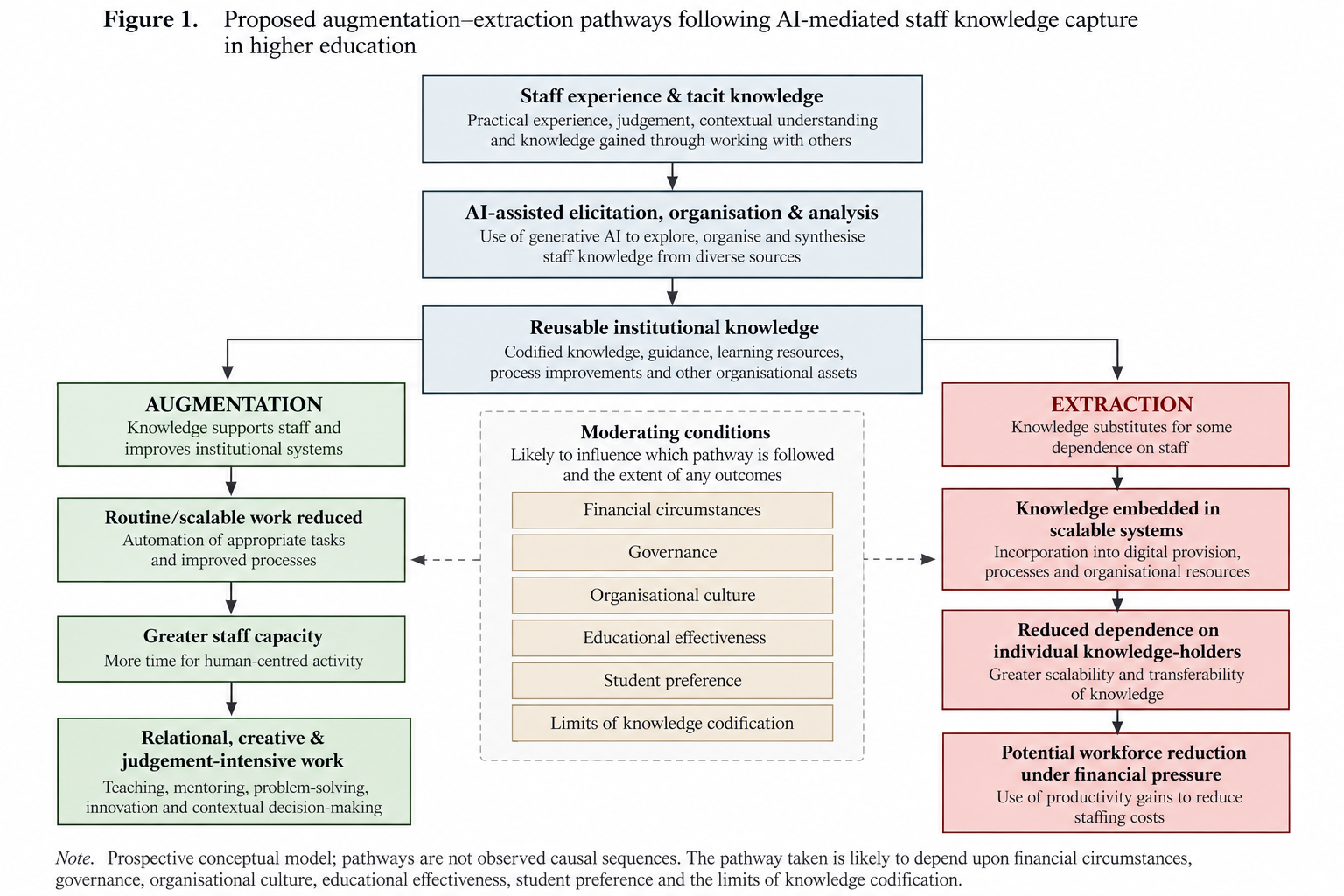
Note. This is a prospective conceptual model, not an observed causal sequence. The pathway taken, and the extent of any effects, is likely to depend upon financial circumstances, governance, organisational culture, educational effectiveness, student preference and the limits of knowledge codification.
Why financial conditions matter
The economic context makes the hypothesis more than an abstract concern. The Office for Students (2026) reported that 35.8% of English higher education providers recorded deficits in 2024–25 and forecast that 42.7% would be in deficit in 2025–26. Universities UK (2026), reporting survey evidence from its members, found widespread use of measures including voluntary redundancy and recruitment restrictions, while 81% of respondents were considering digital transformation.
These observations do not demonstrate that AI is causing job losses in higher education. They should not be presented as though they do.
They establish the circumstances in which decisions about productivity technology are being made. The same technological efficiency can have different consequences in an organisation that is expanding and one that urgently needs to reduce expenditure. An institution in relatively comfortable circumstances might use AI-generated efficiencies to increase human contact with students. One facing an immediate financial deficit may be under much greater pressure to convert the same efficiency into lower staffing costs.
This is why augmentation and extraction may initially be difficult to distinguish. Both can begin with a perfectly reasonable request for staff to share what they know so that the organisation can work better. The difference lies in what happens to the resulting efficiency and, eventually, to the people who supplied the knowledge.
What could prevent extraction?
The extraction pathway is not inevitable. The nature of tacit knowledge itself presents one obstacle. Research on knowledge retention shows that some expertise is difficult to codify because it is situated, relational and acquired through participation (Wikström et al., 2018). AI may capture descriptions of expertise without reproducing the judgement through which expertise is applied. A database containing everything an experienced technician can articulate is not necessarily an experienced technician.
Student preference and educational effectiveness may provide another constraint. If students value access to knowledgeable people, or if human interaction materially improves learning, pastoral support and retention, reducing staff may damage the experience institutions are attempting to improve. Efficiency in one part of a system can create costs elsewhere.
Governance could also influence the direction taken. Institutions might decide that staff-contributed knowledge should carry expectations around attribution, participation and continued human oversight. Productivity gains could deliberately be reinvested in student-facing activity rather than treated automatically as opportunities for reducing headcount.
Finally, institutions may discover that organisational knowledge is much messier than technological enthusiasm suggests. AI systems can organise what people are able and willing to express. They cannot guarantee that the most important knowledge has been expressed at all.
These possibilities matter because the augmentation–extraction hypothesis identifies a risk, not an inevitable future.
Online provision and the separation of knowledge from the knower
The distinction becomes particularly interesting in online and blended education. Digital provision should not automatically be treated as inferior education. It can improve flexibility and accessibility, and AI may make online learning considerably more responsive than earlier generations of digital courses.
Imagine an online programme constructed partly from the accumulated experience of staff. Common misunderstandings have been anticipated, explanations improved and support made available at times when human staff would previously have been unavailable. Administrative friction has been reduced because staff who understand where students struggle have helped redesign the system.
There is nothing inherently undesirable about this. It may be excellent educational design.
The concern arises if success is interpreted as evidence that the people whose knowledge improved the system are now less necessary. Their expertise has contributed to a better educational environment, but some of it has also become detached from them.
The longstanding knowledge-retention literature normally treats this detachment as protection against organisational loss when employees retire or leave. AI introduces the possibility that the same capability might eventually influence decisions about how many people an organisation believes it needs in the first place.
That is the point at which preservation and substitution become difficult to separate.
What universities are actually selling
There is a further tension here. Digital technology is making educational content increasingly abundant while universities continue to depend heavily upon institutional differentiation and reputation.
The maximum standard full-time undergraduate tuition fee at eligible English providers is £9,790 in 2026–27 and is due to rise to £10,050 in 2027–28 (Department for Education, 2025). Current debate has also included arguments for greater differentiation in what institutions can charge. The precise future funding model remains contested. The broader question is nevertheless worth asking: if high-quality explanatory content becomes progressively cheaper to produce, on what basis will universities justify differences in educational value?
Universities plainly do differ. Their research environments, facilities, expertise, communities and opportunities are not interchangeable. The point is not that institutional reputation is meaningless. It is that content may become a progressively weaker basis upon which to claim scarcity.
The things that remain scarce may be less easily packaged: access to knowledgeable people, membership of an intellectual community, being challenged by somebody who understands the subject, or having someone notice that an apparently satisfactory performance is masking a problem. An unexpected conversation after a class may matter. So may the technician who spends extra time showing a student something because they have noticed genuine interest, or the lecturer who changes an explanation after realising the first one has not worked.
These experiences are difficult to scale. They are also difficult to measure reliably.
There is some irony in the possibility that AI could make the things universities have become particularly good at measuring less valuable while increasing the relative importance of things they have always struggled to measure.
Conclusion: October 2026
The purpose of this essay is not to predict that universities will use AI to replace experienced staff. There is currently no adequate evidence for making that claim. It is to record a possibility while the outcome remains uncertain.
Several pieces of the picture are already visible. English higher education is experiencing substantial financial pressure and restructuring. Organisations have long attempted to preserve expertise that would otherwise disappear when experienced employees leave. GenAI is now being considered as a technology capable of assisting with that process by eliciting and organising knowledge at a scale that would previously have been difficult. At the same time, it is reducing the cost of producing many of the polished and standardised outputs that modern organisations have learned to value.
What follows from that combination is unknown.
There is an attractive version of the future in which AI makes institutional language less of a gatekeeper, allows previously overlooked staff knowledge to influence decisions and removes enough routine work to give people more time for the parts of education that depend upon judgement and human relationships. In that version, AI makes the scalable cheaper and the genuinely human more valuable.
There is another version in which institutions become increasingly effective at separating useful knowledge from the individuals who acquired it. Under financial pressure, improved knowledge capture and increasingly capable digital provision could then reduce the perceived need to retain some of those individuals.
The distinction matters because both futures may initially look like progress. Both can begin with better systems, better documentation and an entirely reasonable request: tell us what you know so that we can improve what we do.
The divergence occurs afterwards. Does the institution use the resulting efficiency to give people greater capacity to do the work that does not scale, or does it decide that it can operate with fewer people?
I do not know which outcome will prevail, or whether the distinction will prove as important as I currently suspect. That uncertainty is precisely why I wanted to document the argument in October 2026 rather than reconstruct it retrospectively if events later make it appear obvious.
Perhaps universities will find that tacit knowledge remains far more stubbornly human than current enthusiasm for AI suggests. Perhaps students will place an increasing premium on genuine human contact. Perhaps governance will develop quickly enough to ensure that knowledge contributed by staff strengthens their work rather than weakening their position.
Or perhaps the important transition will turn out not to have been the moment AI learned to generate educational content. It will have been the point at which institutions became sufficiently good at capturing, organising and reproducing what their people knew.
I am close enough to retirement, whether by volition or otherwise, that I may get to watch at least some of this unfold from the sidelines. I hope what emerges is augmentation rather than extraction.
I will keep the bucket of popcorn nearby.
References
Burmeister, A., & Deller, J. (2016). Knowledge retention from older and retiring workers: What do we know, and where do we go from here? Work, Aging and Retirement, 2(2), 87–104. https://doi.org/10.1093/workar/waw002
Department for Education. (2025). Changes to tuition fees: 2026 to 2027 academic year and 2027 to 2028 academic year. GOV.UK.
Edmondson, A. (1999). Psychological safety and learning behavior in work teams. Administrative Science Quarterly, 44(2), 350–383. https://doi.org/10.2307/2666999
Hofer-Alfeis, J. (2008). Knowledge management solutions for the leaving expert issue. Journal of Knowledge Management, 12(4), 44–54. https://doi.org/10.1108/13673270810884246
Hussain, S. A. (2026). A temporal knowledge continuity framework: Explaining delayed performance effects of employee turnover. Knowledge and Process Management, 1–12. Advance online publication. https://doi.org/10.1002/kpm.70140
Hussinki, H., Mikalef, P., & Ritala, P. (2026). Generative artificial intelligence and organizational knowledge management: Four alternative configurations. Knowledge Management Research & Practice. Advance online publication. https://doi.org/10.1080/14778238.2026.2689386
Jisc. (n.d.). Optimising and transforming your approach to AI. AI maturity toolkit for tertiary education.
Klammer, A., & Gueldenberg, S. (2023). Knowledge loss induced by organizational member turnover: A review of empirical literature, synthesis and future research directions (Part I). The Learning Organization, 30(2), 117–136. https://doi.org/10.1108/TLO-09-2022-0107
Nietzsche, F. (2009). Beyond good and evil (H. Zimmern, Trans.). Project Gutenberg. (Original work published 1886)
Nonaka, I., Toyama, R., & Konno, N. (2000). SECI, Ba and leadership: A unified model of dynamic knowledge creation. Long Range Planning, 33(1), 5–34. https://doi.org/10.1016/S0024-6301(99)00115-6
Office for Students. (2026). Financial sustainability of higher education providers in England: 2026. Office for Students.
O'Sullivan, P., Seppälä, S., & Feller, J. (2026). Towards scaling expertise with generative AI: Design principles for governing AI-mediated knowledge capture and transfer. Journal of Decision Systems, 35(1), Article 2669855. https://doi.org/10.1080/12460125.2026.2669855
Polanyi, M. (1966). The tacit dimension. Routledge & Kegan Paul.
Universities UK. (2026). Two in five universities consider joining forces through 'multi academy trust' style models or mergers, new survey shows.
Wikström, E., Eriksson, E., Karamehmedovic, L., & Liff, R. (2018). Knowledge retention and age management – senior employees' experiences in a Swedish multinational company. Journal of Knowledge Management, 22(7), 1510–1526. https://doi.org/10.1108/JKM-09-2017-0442